
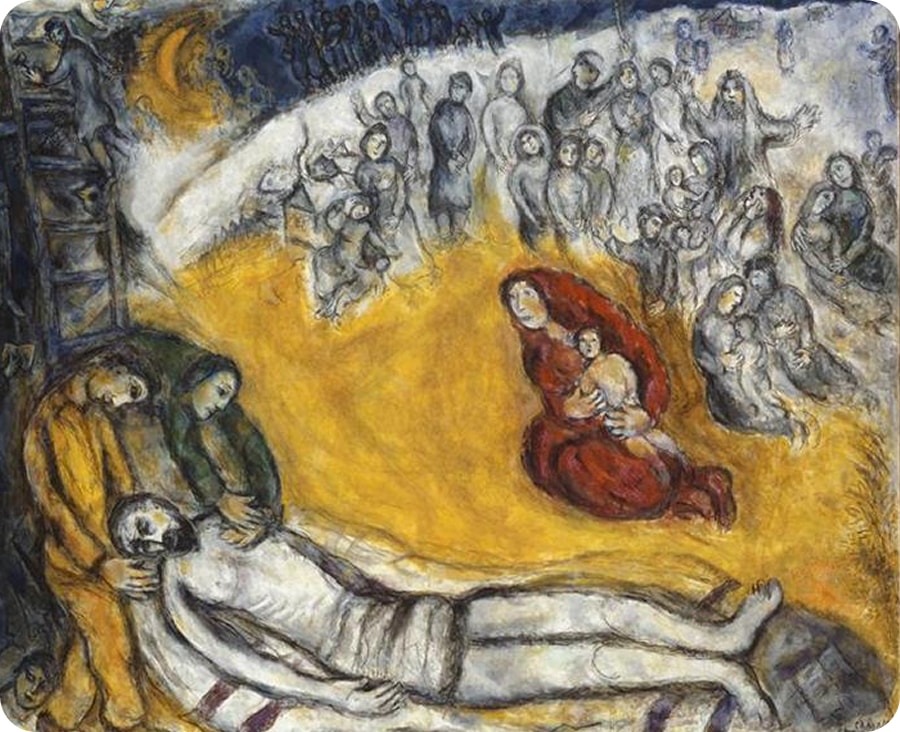
People are shaped by the time, place, culture, and religion in which they live. In the 20th century, within Polish culture, a unique phenomenon was born and raised: Roman Brandstaetter, the writer, poet, and great Biblical scholar. His life and work combined great talents, an unusual biography, and extraordinary grace.
Today we can see how God made use of such a person. Through Brandstaetter, God brought (and brings) many to a deeper faith. I believe that through Brandstaetter’s work, He intends to bring the sons and daughters of Israel to faith in Christ as the True Messiah.
Roman Brandstaetter was born and raised a Jew. He was a Pole, a pre-war major in Polish literature, with a doctorate in philosophy from the Sorbonne in Paris. As an adult – with full clarity of mind and free will– he ‘declared with his mouth and believed in his heart that Jesus Christ of Nazareth is The Son of God, Lord and Savior’ (Romans 10:9). It happened in Jerusalem, during World War II.
How It Happened
Roman Brandstaetter was born in 1906 in Tarnow, Poland, to a practicing Jewish family of the intelligentsia. Love of Scripture was instilled in him from his early childhood. Thanks to his mother, he became familiar with the Word of God and the beauty of Polish language. She would read the Bible to him in its Polish translation by Jakub Wujek. Thanks to his grandfather, Roman would learn the Bible in its original language – Hebrew – by reading it together. His wealthy parents hired a nanny to help with his upbringing: Marynia, a Polish Catholic. During her strolls with little Romek, she would bring him to Tarnow Cathedral for a short prayer. One day, after the prayer before the miracculous image of the Crucified, he asked her:
“Who is he? The man in the crown of thorns, nailed do the cross? Who is he?”
“He is God,” she replied.
“Romek thought: “God? God Almighty? In a crown of thorns? Nailed to a cross? It can’t be the real God!”
He asked Marynia:
“Whose God?”
“Ours…” she answered.”
“Mine?”
“Yours and mine both.”
Fear came over little Roman. He felt as if that Person hanging from the cross was separated from him by some invisible circle he could not cross. Who is He? Why is He on a cross? Why in a crown of thorns? To what end? Nevertheless, he never asked anyone to clarify the doubts distressing him. The Man stretched on a cross filled him with an abiding unease. God had guided Roman’s life. At the beginning of World War II, he somehow managed to escape Warsaw, where his family was trapped in the Jewish Ghetto.
All of them – his parents and his beloved grandfather – were later murdered by the Germans in Treblinka. Brandstaetter reached Vilnius. From Vilnius, which had been first occupied by the Soviets, then later briefly captured by Lithuanians, his travels went farther. By the kindness and help of different people and the actions of Divine Providence – through Moscow, he reached Jerusalem, the Holy City of prophets and kings, the city of the Temple of Israel. Also, the Holy City of Christ, of His life, teaching, death and Resurrection. A City with a great and tragic history, as grand and tragic as the history of the Jewish nation itself.
Brandstaetter worked in Jerusalem as a radio operator for the Polish Telegraph Agency. But above all, he walked in the footsteps of Jesus. He prayed in the places where Jesus of Nazareth walked. He read the Gospels.
He was amazed by the veracity of the sacred text. As he recalled, he had been particularly impressed both by the descriptions of the places of Christ’s Passion and also by the straightforward descriptions of the climate and weather. One day, he found the following words in the Gospel according to Luke: ‘When you see a cloud rising in the west, you say at once, ‘A shower is coming.’ And so it happens. And when you see the south wind blowing, you say, ‘There will be scorching heat,’ and it happens. You hypocrites! You know how to interpret the appearance of earth and sky, but why do you not know how to interpret the present time? And why do you not judge for yourselves what is right?’ (Luke 12:54-57). That day in Jerusalem, the weather was exactly that way…
The Biblical Night – A Beam of the Most Brilliant Light
The War was nearing its end. A December night came, or as he called it, the Biblical Night. He would recall: ‘I was done with my work after midnight. I smoked a cigarette. I got up from the table, looked around the room, and remembered I had nothing to read at home. My eyes stopped at a pile of old magazines. I grabbed a few issues at random. A sizeable leaflet dropped to the floor out of one of them. I picked it up. It was a reproduction of a 17th century sculpture by Innocenzo da Palermo from the San Damiano church in Assisi. I glanced at it. It represented Christ moments after his death. His last breath had just drawn from his half-parted lips. His eyes were shut but He was seeing. A spiked crown rested on his head like a bird’s nest made of thorns.
Though His head leaned helplessly towards his right shoulder, on His face, there was focused hearkening to everything that was happening around. This dead Christ was alive. I thought: God. And, putting the picture in my briefcase, I left. (…) Even after that, the dark side of eternity would still cast a long shadow on those areas of my allotted time, and introduce a lot of discord and disorder into those days of mine, nevertheless, the history of that Biblical Night was to me like a beam of the most brilliant light I have ever seen in my whole life.’ (Quote from Krąg biblijny, an autobiographical work by Roman Brandstaetter). Brandstaetter never parted with that magazine image of Christ. It was hung at a wall in his room. It was his writing muse. He asked for it to be placed in his coffin.
A Meeting, not a Conversion
Brandstaetter never defined that experience in terms of conversion, for he has always been a deeply religious and a moral man. For him, it was a completion of his Jewish faith. He experienced the New Testament as a fulfillment of the God’s promise in the Old Testament. It was the Grace of meeting Christ, a Jew like him. It was the greatest joy of his life. He confessed: ‘The great spiritual heritage shared by Christians and Jews reassures me in my conviction that my “departure” from Judaism, my “betrayal” – as some would like to see it – it is not a departure in the literal sense. I’m touching both ends of the arc. I am awaiting this great bridge. I wish to act as if God dwelt in me.’
He was baptized into the Catholic Church in Italy in 1946. After the turmoil of war, he returned to Poland. Having experienced various setbacks in his plans from the communists, he finally settled down in Poznan. There he wrote dramas, poems, and Bible-inspired hymns. That is where he wrote his stories, inspired by St. Francis of Assisi, another of his fascinations. He translated Sacred Scripture from Hebrew and Greek. The translations were brilliant, on par with Jakub Wujek’s Bible. Unfortunately, he had never managed to translate the entire New Testament, only some of its books. A frugal, unusually active and busy life: faithfulness to God, prayer, Holy Mass, the sacraments.
Magnum Opus: Jesus of Nazareth
Roman Brandstaetter wrote his greatest literary masterpiece in Poznan between 1967 and 1973: a four-volume novel Jesus of Nazareth. The text is a testimony to his faith in the historical Christ. It was written in crystalline Polish, but above all, shows Christ – His life and times – through Jewish eyes, with a Jewish mind. An exegetical novel, allowing us to understand the world and the nation where God came to earth to perform the works of Redemption. It clarifies many parts of the Gospel that are hard for Christians to understand. He shows Jesus not according to our Latin ideas, but as the One who combines the greatness and the holiness the Old Testament Yahweh God and that of the Son of God who became the true Man in a particular country, in a specific culture, “in the fullness of times,”, in a nation that was brought into existence, sustained, and led by God.
The text is replete with realistic descriptions combined at the same time with great poetry. Here are two examples of such inspired poetry, excerpted from the descriptions of the Annunciation and of the Resurrection: ‘She went outside the dwelling. She sat down on the ground by the road, in the full sun, with her legs tucked under her, and she looked up at the clear blue sky, without a single cloud, stretched like a silk tent from Jezreel to Carmel and the mountains of Naphtali.
Tired, Miriam closed her eyes and remained still, enjoying the peace and silence flowing from the fields and valleys, saturated with the scent of fresh herbs. Suddenly, she felt a shadow over her, wrapping her more and more tightly. She immediately opened her eyes and saw a shadow streak falling on her, even though there was not a single cloud in the scorching sky. Nevertheless, the shadow fell from a cloud, for the shadow was a cloud, and the cloud was a shadow; thus, together they were Shekhinah, the presence of Yahweh. It was His dwelling and His revelation, the shadowy-cloudy I AM, flowing into Miriam’s blood and, together with the blood, filled all the cells of her body, to the very limits of her being. She closed her eyes.’
The text is replete with realistic descriptions combined at the same time with great poetry. Here are two examples of such inspired poetry, excerpted from the descriptions of the Annunciation and of the Resurrection: ‘She went outside the dwelling. She sat down on the ground by the road, in the full sun, with her legs tucked under her, and she looked up at the clear blue sky, without a single cloud, stretched like a silk tent from Jezreel to Carmel and the mountains of Naphtali.
Tired, Miriam closed her eyes and remained still, enjoying the peace and silence flowing from the fields and valleys, saturated with the scent of fresh herbs. Suddenly, she felt a shadow over her, wrapping her more and more tightly. She immediately opened her eyes and saw a shadow streak falling on her, even though there was not a single cloud in the scorching sky. Nevertheless, the shadow fell from a cloud, for the shadow was a cloud, and the cloud was a shadow; thus, together they were Shekhinah, the presence of Yahweh. It was His dwelling and His revelation, the shadowy-cloudy I AM, flowing into Miriam’s blood and, together with the blood, filled all the cells of her body, to the very limits of her being. She closed her eyes.’
And ….
‘Resurrection.
There was silence.
A giant invisible shadow
Passed over the peak of Golgotha,
Overshadowed the motherly rock
And as a long violet shadow streak
It rested upon it,
Like that day
Upon the eyelids
Of young Miriam.’
Only the words recorded in the four Gospels are put in Christ’s mouth in Jesus of Nazareth. But he brings his cultural knowledge and artistic skills to bear on the characters of Mary, St. Joseph, Zechariah, Elizabeth, John the Baptist, the Apostles, Simeon, and the holy women. The same talents also color Christ’s enemies: of Caiaphas, Annas and their servants, of Judas, Pilate, Herod and his lover Herodias, and many of the Phariseesl They are all painted with passion, showing the nobility of the former and the wickedness of the latter.
Yeshua ben Yosef the Messiah?
In Jesus of Nazareth, at the very end, there is a short personal note, the only one in such a vast text. It is, at the same time, a statement on how difficult it is for Israel to believe in Jesus Christ as the Messiah, the Son of God. It is Roman Brandstaetter’s personal reflection. The scene takes place after the Ascension of Christ.
‘Late afternoon they left the Temple. At the same hour, a certain elderly Pharisee, returning home from his stroll in the valley of the Kidron, he saw from a distance a small group of unknown men and women going towards the Upper Town. As he walked by them, he overheard fervently discussing some sort of a miraculous event they had witnessed. The Pharisee stoped and asked them:
– What is this lively conversation about, my brothers?
– About the Messiah, kind sir – one of them replied.
– Pray, so he may come – said the elder.
– He already has! – Cried a young man with a feminine face.
– Already? – Old man’s voice trembled.
– Yeshua of Nazareth is the Messiah. Have you heard nothing of him, kind sir? – they cried.
The old man shrugged in disbelief and, leaning on his cane, walked slowly uphill, to his white house on the slope, among the dark cypresses, the trees pleasing to the Lord. Yes, he had heard of the Man of Nazareth. He had heard of His wisdom and kindness, of his teachings and miracles, of his martyr’s death and resurrection. He could not see blame in the Accused. He considered it a shameful act to hand over the son of Israel into the hands of pagan torturers.
But Yeshua ben Yosef the Messiah? Yeshua ben Yosef the Son of God? Yeshua ben Yosef has risen? The old man sighed. He stopped. He sat on a roadside boulder. He pondered. And he was a forefather of the one who wrote this tale of Jesus of Nazareth.’
The Task
Roman Brandstaetter died in 1987. On his grave at the Milostovo cemetery in Poznan, the words from the 1st Letter of St. John are inscribed: We have passed from death to life (1 John 3:14).
St. John Paul II valued this great writer highly. He met Brandstaetter several times and read his works. Like Brandstaetter he felt that the history of Poland and the Polish nation – so strangely intertwined with the history of the Jewish people – constitutes a great honor, but also a task. What kind of a task? We are to pray for faith in Christ for them. We are to proclaim to them Messiah to them, the Savior of the world, Jesus of Nazareth, so that they would encounter and believe in Him. So that, like Roman Brandstaetter in his Biblical Night, they too could see the beam of God’s most brilliant light. So that, like Edith Stein – St. Teresa Benedicta – they would say from the bottom of their hearts about Christ: this is the Truth! So that – like it happened for Rachela Drążek, aka Sister Paula Malczewska (1929-2019) for whom a roadside cross in Nazi-occupied Poland led the way to Christ – the sight of the Cross would make them burst with love for Jesus. So that – as it happened for so many sons and daughters of this noble nation – they could accept Christ, who was born of them, and first came to them.