
Novel
In this section we present our english translation of ‘Jesus of Nazareth’. It is the first such translation of this unique novel.
Old Man's Joy
It was a moonlit night when the mute was returning from Jerusalem to Ein Karem. Descending into the ravine between the olive orchards and the terebinth forests that grew on its slopes, he looked back (it was his custom to stop here whenever he left Jerusalem to embrace the vista of the city with his intent and blessing gaze) and he saw the heaped-up houses of Zion and Acre in the moonlight above, and above them the golden-fawn body of the Temple, with which he so far had always parted with regret, but this time – with embarrassing relief and an unusual haste. But the closer he was to home, the greater was his excitement, and so, to wise Midbar’s dismay, as she was rushing towards the tasty fodder, he would tighten her bridle again and again, forcing her to walk slowly. Though it was in accordance with the donkey’s contemplative personality, it ran against the needs of her empty stomach. He sat comfortably in the red saddle and, as he rode, with each step he pondered how to tell his wife about his vision despite his muteness; the vision which he maybe could have warily held back from her if not for the poignant awareness that it concerned her as much as him, and perhaps her above all. When the donkey finally began to climb up the dark glen slope (having traveled it countless times, Zechariah knew this route well), the view of Ein Karem on the terraces unfolded before his eyes, still distant but distinct; and then Zechariah felt as if he was on a run. So he resisted this feeling, because in no way did he consider his departure from Jerusalem to be an escape – he left at the prescribed time, after having completed all his priestly duties. He was, undoubtedly, returning home to bring magnificent, joyful, and good news. If he was insecure, it could only be because of the foretold future of the child, for Zechariah knew that the fate awaiting the boy, even though blessed, was a rough one as well; like the fate of all men upon whom the gaze of Elohim was set.
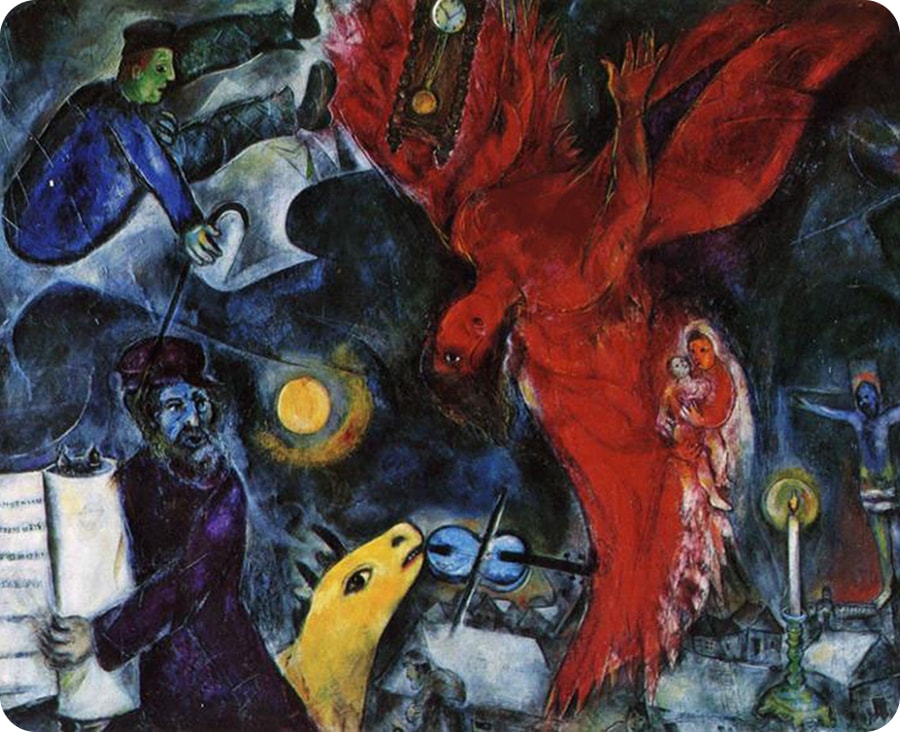
Zecharia tried to recall, as accurately as he could, everything he saw and heard in the Tabernacle. He has never seen an angel before. It would be hard for him to describe the man who formed before his eyes from the smoke of incense. It wasn’t a human figure, although it had all the characteristics of a human figure. It’s hard to even call it a figure, since even the words spoken by the mysterious messenger weren’t really words but rather raw notions, working without a medium of any sound, and even if Zechariah thought of it as “the Voice”, it was only because he could not find any other term to describe the apparition used by Elohim to convey the joyful news. Zechariah knew the angel, and everything he had told him, had to be translated into human speech, which wasn’t easy, especially for a mute. As a Man of the East, he was able to express his soul with gestures, but still he couldn’t tell the story of that moment before the Altar of Incense, even with the widest range of gestures or the sharpest facial expressions. So he resigned himself to the thought of Elisheba not learning about his conversation with the Voice for some time, but the idea of the poor woman lamenting over his disability saddened him greatly; and so he felt somewhat resentful with the Voice for resorting to such an elaborate act instead of simply binding him with a solemn oath to keep the happening in the Tabernacle a secret. He didn’t pay much attention to the clear statement of the Voice announcing his muteness as a punishment for his benign disbelief, as he considered the whole ordeal merely a sacred excuse on Elohim’s part. It’s true he took that blessed augury with a pinch of uncertainty and confusion, understandable for a man his age, but there was no rebellion or disobedience in this reaction (only that denying head motion, resembling the pendulum swings of the censer, was a bit unfortunate). But since he wasn’t sure whether he really resisted the doubt in what he had heard, he began to pray to El Shaddai and begged him to cast away that sin of unbelief; and looking with his old but bright eyes to the sky graying in the east, he admitted before the cheerful-stern visage of the Lord that it was indeed too easy for him to justify that ungrateful feeling with which he greeted His speaking Voice in the Tabernacle.
The sun was already rising when Zechariah, rocking on the back of the wise donkey Midbar, arrived home and stretched his arms helplessly towards Elisheba awaiting him at the doorstep. It took a longer while before she understood Zechariah had lost his tongue.
She looked at her husband with terror.
Nebulously, she recalled the voice of her deceased father, also a priest, who used to say that great things can arise from silence. Driven by a premonition, she quickly associated her husband’s sudden disablement with her own condition, which she had not yet been able to tell him about: during his absence she had discovered, to her joyful surprise, that she was in a blessed state.
Shocked by this discovery, she couldn’t wait for her husband to return. When she was doing her chores, dishes fell out of her hands; she wandered aimlessly around the house, praying fervently and thanking Elohim for raising His horn over her, and for showing her his favor, and for creating the miracle in her womb. But as she passed her neighbors, she kept her head down; she was just as quiet and modest and just as ashamed as before, only now not with the bitter shame of barrenness, but with the sweet shame of bearing a child.

Looking at Zecharia, she decided to be careful with her premonitions and ideas, and, with cold calculation, she listened to her inner voice, trying to examine its source warily. If there really was a connection between Zechariah’s silence and the voice of her womb, the child to be born would be destined to fulfill a higher purpose, but Elisheba in her humility dreaded to think about it. Unwilling to sin with pride, she preferred to admit her feelings were confused rather than look for a divine sign in her husband’s sudden muteness. Contemplating all these matters, doubts, suspicions, the uncertainty, the mystery, and angst, she came to the conclusion that the mysterious and unexpected crippledom of her husband was a good thing. Poor Zecharia was not always able to remain silent and, befittingly for a good person, he liked to share all good news with the neighbors, but now, by his disablement he was cured of his kind-hearted verbosity so that whatever he hears, he will keep a secret. Facing her husband, Elisheba looked tenderly upon his old wrinkled face and was glad that he could not speak, while Zechariah, looking with equal tenderness at the weary face of his aging wife, lamented deep in his heart that he could not tell her everything. And so they stood facing each other for a longer while, rejoicing in the same idea and lovingly hiding it within their hearts. Until at last Elishba leaned towards her husband and trustfully whispered a few words in his ear. Zechariah, deeply touched, gave way to a sudden delight and tilted his head back. Remembering in his mind King David, who had danced before the Ark of the Covenant in the streets of Yerushalayim Ha-kodesh, and had leaped and clapped his hands in the presence of the Elohim, Zechariah began to dance and leap and clap around the bewildered Elisheba. It seemed to him, in a vague and far image, that the fruit which his old wife was bearing in her womb, was the voice of the lost Ark of God. Unable to sing out loud – since his lips were mute – he silently sang a psalm “Not unto us, oh Lord, not unto us, but to Your Name give aglory”, and Elisheba read from his lips that this dance was accompanied by the words of praise to El Shaddai, God Almighty.