Novel
In this section we present our english translation of ‘Jesus of Nazareth’. It is the first such translation of this unique novel.
The Annunciation
The world of Nazareth, where little Miriam lived, was a tiny place. It consisted of mud huts, caves, a town well, and a synagogue on a hill. Even if we expand it to include a dozen more mud huts and caves located a little further away, it was still very small. The imagination of its inhabitants, although undoubtedly vibrant and passionate, did not extend far beyond their rooms, hills, and gardens, beyond poverty and even misery, for sometimes only a handful of broad beans and barley groats were the fruit of their labor and the object of their deepest desires. All year long, they lived dreaming of a pilgrimage to Jerusalem for the Celebrations of the Great and for this purpose they diligently saved money. In order to save some money for Passover, Rosh Hashanah and Yom Kippur in the distant Holy City, they sat in the dark unlit rooms on weekday evenings, ate dried locusts or denied themselves wine. These holidays could not be imagined without the presence at the Temple of the Lord at the foot of the Shekhinah.
On solemn days, regardless of whether they were rich or poor, wise or am ha’aretzi— all the Children of Israel would become equal in front of its invisible face. These pilgrimages were their sacred desire. They undertook them for Elohim and for a sense of their equality before Him.
However, the life of little Miriam was very different. Although poverty was also the lot of her parents who worked hard for their daily bread, the town where a lively, cheerful, and smiling twelve-year-old girl lived, felt bigger for her than it was for her neighbors.
One day, Jehojakim and Hana went to work in the vineyard that belonged to a wealthy Nazarene, whose house and gardens were situated near the valley, beyond an oak forest. As every other day, their daughter Miriam bustled about the chamber, which was dark and smoky, but tidy, what makes it even more commendable, because it was not easy to maintain order and tidiness in this place of living carved into the rock. Admittedly, it was more of a cave than a house. There was not much furniture in there: three beds, a table, some chairs, a stove with an oven, several knives, clay jugs for water and flour, and a chest for poor, unadorned clothes.
Miriam, whenever she was alone in this cramped room, as it happened every day except the Sabbaths, she felt as if it was a vast and infinite kingdom, for she populated it with thoughts that revolved with equal concern around daily chores and household duties, as well as matters distant, elusive, unreachable by hand or eye. Perhaps, they were echoes of her father’s colorful and vivid stories of The Wisdom that rose like mist from the lips the Ancient of Days, Who lived on pillars of clouds and strolled across the sky and the abyss. According to her relatives, neighbors, and acquaintances, Miriam was a rather strange girl. They knew that she was engaged to Joseph the carpenter, that their wedding was to take place in a year, that she was strong and thrifty, that she had a good and tender heart, and that, owing to those qualities, she would surely make a good wife and a mother. It is highly possible that the people of Nazareth saw that strangeness in her inclination to sing and compose songs.
When evenings fell, Miriam would sit cross-legged at the entrance of the chamber surrounded by the circle of attentive parents, relatives, and neighbors, and sing songs of her own composition, in which she mixed words borrowed from psalms and prayers solemnly recited by Jehojakim on holidays and the Sabbath, with her own ideas, parables, comparisons, and metaphors, as a result of which they could be safely described as inspired variations on a chosen theme. No one in Nazareth composed psalms and melodies. Therefore, her relatives and friends nodded their heads recalling from their biblical memory the figures of women composing songs – Miriam, the sister of Moses, Hannah – the mother of the man of God – beloved by the Lord, Samuel; and Judith, the blessed widow. Nevertheless, it was difficult to tell whether they were praising or criticizing the poetic skills of Miriam, a poor man’s daughter.
That day, as mentioned, when Jehojakim and Hana went to work, Miriam was doing her household chores from the early morning. She beat mats outside, fetched some water from the well, washed the dishes, and subsequently, went outside the house. She knelt down and ground the wheat grain singing to Elohim and synchronizing her song to the rhythm of her work. The quern was borrowed from her neighbor, and the wheat was a gift her father had received from his employer. She performed her work calmly, without haste, and with that monotonous patience being so characteristic of the daughters of Israel when work manually.
Slowly but effortlessly, she turned the upper stone with her left hand, and with her right she poured the wheat into the opening. Then, she shook the sieve, separating the bran from the flour, which to her delight, ever so often flew up and fell as white dust covering her hands. Looking at her wet fingers, she remembered her father’s story about distant Mt. Hermon, which was covered with snow all year long. Although she had only known snow from that story, she imagined it must be very beautiful and extremely white. After all, it was a gift from the Ancient of Days and was used in one of the psalms that Jehojakim particularly loved to use for a comparison escribing immaculate whiteness. She smiled, remembering the words of her father who used to say: “And my daughter, Miriam, is swarthy, for the sun has burned her. However, despite her swarthiness, she is purer and whiter than snow.” Pondering the difficult question of how one could be whiter than snow if one’s skin is sunburnt, Miriam got up from her knees and went into the room to fetch a clay jug for the flour.
She rubbed her eyes with her fingers. The smile slowly faded from her face. She felt uncomfortable.
A cold shiver ran through her body. She turned toward the door and wanted to run out, but she could not take a step. She stood motionless, stunned. Suddenly, she saw some illumination within herself, but it was not due to sunlight or moonlight, neither was it the light of an oil lamp, because it was not lit. It also bore no resemblance to any light at all, as it was only that what it was not, and what it would never be, but what it Is. So, within herself, she saw as The One Who Is was walking toward her from a distant-close space, unlimited by any boundary or definition, for He was Himself the boundary and all the definitions. Therefore, walking towards her, He did not actually walk, for he was beyond all time constrains – but rather he was becoming before her eyes.
Actually, He was not becoming, because He Who Is cannot become. Therefore, to make it easier for little Miriam to comprehend what was happening, He Who Is adapted and bent His actions, not so much to certain human concepts, but rather to the forms of human language – He simultaneously formed Himself before her eyes as the Messenger in a white linen tunic, girded with a silk belt, interwoven with gold threads and decorated with sapphires. He was the confirmation of what was happening inside her and what she saw in her inner delight. It was caution – typical of Elohim, Who knowing man’s fondness for visual perception, wanted to make it easier for the young girl to understand the extraordinary Mission. Thus, He did not limit Himself to just an internal action, but spoke to her in reality.
Hence, He graciously multiplied His presence appearing before Miriam’s eyes as the Messenger of Himself, since it is well known that the emissary bringing the news, constitutes the one who sends it. Miriam was carefully observing the Messenger, whose somewhat sluggish movements, so characteristic of angels clothed in human flesh, confirmed the difficulties he had moving around on earth. The girl listened attentively and humbly to his greetings as He began to speak in human speech. Opening His mouth, The Messenger translated into a human language everything little Miriam heard in the unspoken language, in an intricately simple manner. He greeted Miriam in the Name of Grace, with which she was filled, and in the Name of Elohim, who blessed her among all women. Focused and tense, Miriam was marveling at each word separately, subsequently combined those words into a sentence which, admittedly, possessed an undeniable charm; however, she couldn’t understand why a small, insignificant girl, a daughter of tired laborers, the fiancée of Joseph the carpenter, should be full of the Grace of Elohim and blessed among women.
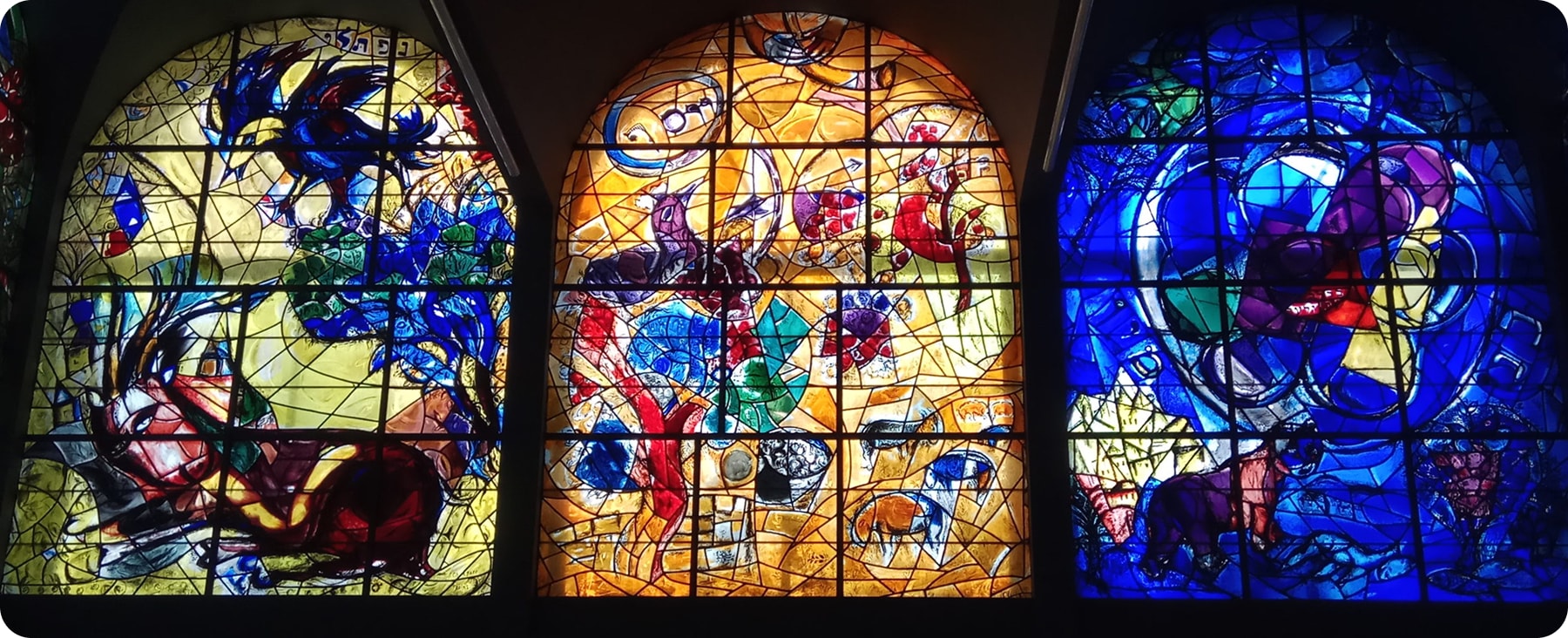
Undoubtedly, The Messenger guessed her thoughts; hence, he spoke to her again and asking her not to be afraid, announced to her that she would conceive and bear a Son, Whom he would call Yeshua, which means: The Lord is salvation, and He would be great and would be called the Son of The Most High, and Elohim would give Him the throne of David, His father, and He would reign over the house of Jacob forever, and His kingdom would never come to an end. Everything uttered by The Messenger was said coherently, in a melodious tone, with accentuated meaning of certain words and emphasized intonation. Nevertheless, not once did the Messenger fall into excessive pathos, which confirmed gis artistry in translating the commands of Elohim into a human language. This solemn and modest melody was very precisely measured, and, thus, it combined the truth of heaven and the truth of earth into a single, indivisible union. It was greatly significant, because the deeper meaning of the mystery that was happening here, lied exaclty in that challenging union.
Miriam listened calmly to the Messenger. Not a single muscle twitched on her dark, silent face, and she was on a verge of expressing her submission to the Lord, yet she could not resist this one embarrassing question. She felt the undeniable urge to ask it, because her dignity demanded it. She began to wonder how to express it in a concise manner, removing all the superfluous elements, in order to get rid of its burden. She wanted to use a symbol for this purpose, but creating a substitute image in a hurry, so that it would convey her thoughts, was extremely difficult. Disheartened by her own efforts, she simply asked how it would happen, since she did not know her husband. The Messenger replied that the Holy Spirit would come upon her, and the power of the Most High would overshadow her. Therefore, The Child to be born from her will be holy and will be called The Son of God. He stopped there. Miriam lowered her head.
Two short black braids, held in a tight knot at her neck, suddenly loosened and fell onto her shoulders as she moved. The Messenger realized that the girl still wanted to ask further questions, thus, anticipating their meaning, he formed the answers. He quickly explained that Elishba, her relative, despite her old age, had conceived a son, and that the one who was considered barren, is already in her sixth month, for nothing is impossible with Elohim. Miriam raised her head. Submitted to God’s Will, she understood that without hesitation she should loudly express her consent to what was about to happen, and she was determined to express it with the most beautiful words and the sweetest melody, but she lacked the beautiful words and there was no sweet melody.
With great difficulty, she managed to articulate a whisper through her constricted throat: “I am the servant-girl of Elohim, therefore let it be done according to His word”. The Messenger vanished without a trace, moving away from her and within her, while Miriam returned from her hidden inner self to the reality of the humble chamber, the jugs for water and flour, and the sieve lying on the threshold. Only her blue eyes full of joyful concern, feverishly and restlessly sparkling under black-arched eyebrows, revealed that she had been struck by the gentle thunder of the Lord of the highest mountains, El Shaddai.
She went outside the dwelling. She sat down on the ground by the road, in the full sun, with her legs tucked under her, and looked up at the clear blue sky, without a single cloud, stretched like a silk tent from Jezreel to Carmel and the mountains of Naphtali. Tired, Miriam closed her eyes and remained still, enjoying the peace and silence flowing from the fields and valleys, saturated with the scent of fresh herbs. Suddenly, she felt a shadow over her, wrapping her more and more tightly. She immediately opened her eyes and saw a shadow streak falling on her, even though there was not a single cloud in the scorching sky.
Nevertheless, the shadow fell from a cloud, for the shadow was a cloud, and the cloud was a shadow; thus, together they were Shekhinah, the presence of Yahweh. It was His dwelling and His revelation, the shadowy-cloudy I AM, flowing into Miriam’s blood and, together with the blood, filled all the cells of her body, to the very limits of her being. She closed her eyes.
At that moment, Josef ran down the hill, out of breath, stood in front of Miriam and, stretching out his arms to her, wanted to call her with a loving word. However, as he noticed the shadow cast over her figure, he shivered and quickly withdrew his arm, uttering a whisper:
“What’s wrong, Miriam?”
Yet, he heard no answer, but only saw a violet shadow slowly passing over her lips and closed eyes.